3D Printing Explained: From Layer by Layer to Finished Product


3D Printing Explained: From Layer by Layer to Finished Product
In just a few years, 3D printing has evolved from a futuristic concept into a practical tool used across industries, healthcare, education, and even in people’s homes. But how exactly does a digital design become a physical object – built up one layer at a time? This article introduces how 3D printing works, the main technologies behind it, and how it’s being used across the UK and beyond.
From Digital Design to Physical Object
Every 3D print starts with a digital model. This can be created in a 3D design program such as Fusion 360, Tinkercad, or Blender, or scanned from an existing object. The model is usually saved as an STL file, which describes the object’s surface using thousands of tiny triangles.
Next, the file is processed in a slicer program, which converts the model into instructions the printer can follow. The slicer divides the model into hundreds or thousands of thin layers and calculates how the printer’s nozzle should move to build the object layer by layer. The result is a G-code file, which is then sent to the printer.
The Layer-by-Layer Principle
At the heart of 3D printing lies the layer-by-layer principle. Unlike traditional manufacturing, which removes material through cutting or milling, 3D printing adds material one layer at a time. This approach allows for the creation of complex shapes that would be impossible or extremely costly to produce otherwise.
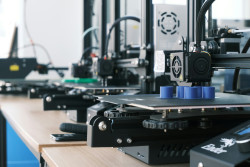
The most common type of 3D printer for home and educational use relies on FDM (Fused Deposition Modelling) technology. It works by melting a plastic filament – typically PLA or ABS – and extruding it through a heated nozzle that moves in precise patterns. As the plastic cools, it solidifies, forming a strong structure.
Other technologies, such as SLA (Stereolithography) and SLS (Selective Laser Sintering), use light or lasers to cure liquid resin or fuse powdered material. These methods often produce higher detail and smoother surfaces, making them popular in professional and industrial settings.
Materials: From Plastic to Metal
While plastic remains the most common material, today’s 3D printing offers a wide range of options:
- PLA (Polylactic Acid) – biodegradable and easy to print, ideal for prototypes and educational projects.
- ABS (Acrylonitrile Butadiene Styrene) – durable and heat-resistant, often used for functional parts.
- PETG – combines strength and flexibility, suitable for mechanical components.
- Resin – used in SLA printers, providing smooth finishes and fine details.
- Metal and composite materials – used in industrial applications such as aerospace, automotive, and engineering, where strength and precision are essential.
The choice of material depends on the purpose of the object – whether it needs to be decorative, functional, or highly durable.
Applications Across the UK
3D printing is now used in a wide variety of fields. In manufacturing, it enables rapid prototyping, allowing designers to test and refine products before mass production. In healthcare, British hospitals and research centres use 3D printing to create custom prosthetics, dental implants, and surgical models tailored to individual patients.
The construction industry is experimenting with 3D-printed housing, where robotic arms lay down layers of concrete to form entire structures. Meanwhile, in fashion and design, 3D printing is being used to produce bespoke jewellery, clothing, and furniture.
For individuals, 3D printing has opened up new possibilities for repair and creativity. A broken appliance knob, a missing toy part, or a custom phone stand can be printed at home within hours. Many UK schools and makerspaces now use 3D printers to teach design, engineering, and problem-solving skills.
Læs også:




Benefits and Challenges
The advantages of 3D printing are clear: flexibility, speed in prototyping, reduced waste, and the ability to produce complex geometries. However, there are also challenges. Printing can be time-consuming, and the final quality depends on both the printer’s precision and the user’s experience. Materials and maintenance can also add to the cost, particularly for professional use.
Environmental impact is another consideration. Although PLA is biodegradable, its production still consumes energy, and not all materials are recyclable. Researchers and UK-based startups are exploring sustainable alternatives, such as recycled plastics and bio-based filaments, to make 3D printing greener.
The Future of 3D Printing
The technology continues to advance rapidly. New printers are becoming faster, more accurate, and more affordable. The range of printable materials is expanding to include carbon fibre, ceramics, and even biological tissue. In the future, 3D printing could play a central role in manufacturing, medicine, and even food production.
Imagine being able to print spare parts directly at home, or hospitals producing patient-specific organs on demand. What once sounded like science fiction is steadily becoming part of everyday life – one layer at a time.
Læs også: